Surrealism
in its purist state is the representation of the mind, that of the flow of
ideas, conceptions and memories. Surrealism aims to represent what cannot be
represented, aims to capture something that is just beyond the reach of the
conscious mind. Andre Breton aims to lay the foundation of Surrealism in the
First and Second Manifestos of Surrealism, primarily in this conversation the
First Manifesto will be referred to. Breton lays out the aim of Surrealism to
represent in literature and in art a true manifestation of thought, thought
without control and without rational boundaries, thought that is experienced in
the dream state. Breton argues that these thoughts and these conceptions should
be and can be realized through the flowing of thoughts onto paper, the
representations of dreams, which while dreaming man does not find to be so
insane, but while awake seem to be unfathomable and irrational. Breton defines
surrealism as, “Pure psychic
automatism by which it is intended to express, either verbally or in writing,
the true function of thought. Thought dictated in the absence of all control
exerted by reason, and outside all aesthetic or moral preoccupations.” Though
Breton makes large claims that surrealism is the key to unlocking the dream
state, and that this can be represented in various forms did not go
uncontested.
 Max Morise and Pierre Naville both
critiqued the idea of surrealism, and respond to Breton’s manifesto with the
question, can the unconscious truly be represented? Pierre Naville simply states,
“Everybody knows that there is no surrealist painting.” Naville argues that the
unconscious cannot be represented, at least not in painting. Is this true? Can
the unconscious be represented in painting? Can the unconscious be represented
in any medium? Max Morise addresses the representation of the unconscious in
his critique The Enchanted Eyes
(translated from French) and posits that the unconscious and the surrealist
goal of representing it can be realized perhaps in writing, but not in
pictures. Morise suggests that this goal to represent the psychological state
and the seemingly irrational dream state can perhaps be realized, however the
images of dreams and memories are inherently tainted by the conscious mind.
Morise also states that stream of thought cannot be viewed statically and is
ever changing. Morise brings to light the inherent relationship between
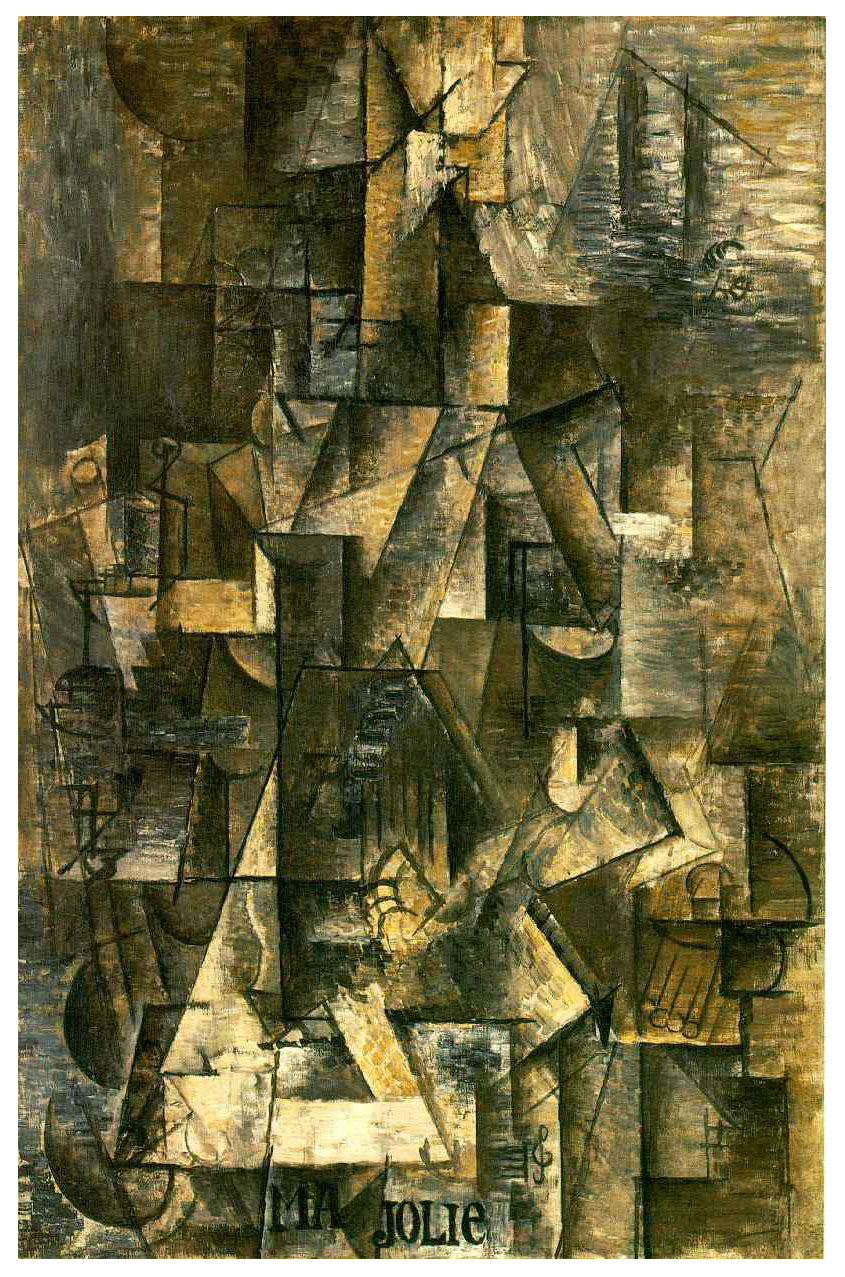
pictorial systems and ideas, pointing to Picasso’s use of pictorial language. Morise even states that cubism is in way “automatic” in line with that of
surrealism. Keeping in mind Picasso’s Ma Jolie, 1911 pictorial language is
challenged and the intellectual relationship removed in a sense. This precursor
to surrealism took the idea of representation and turned it on its head in an
effort to deconstruct pictorial language. In a similar way surrealists aim to
represent what has not been represented, to represent thought and ideas without
control.
Max Morise and Pierre Naville both
critiqued the idea of surrealism, and respond to Breton’s manifesto with the
question, can the unconscious truly be represented? Pierre Naville simply states,
“Everybody knows that there is no surrealist painting.” Naville argues that the
unconscious cannot be represented, at least not in painting. Is this true? Can
the unconscious be represented in painting? Can the unconscious be represented
in any medium? Max Morise addresses the representation of the unconscious in
his critique The Enchanted Eyes
(translated from French) and posits that the unconscious and the surrealist
goal of representing it can be realized perhaps in writing, but not in
pictures. Morise suggests that this goal to represent the psychological state
and the seemingly irrational dream state can perhaps be realized, however the
images of dreams and memories are inherently tainted by the conscious mind.
Morise also states that stream of thought cannot be viewed statically and is
ever changing. Morise brings to light the inherent relationship between
pictorial systems and ideas, pointing to Picasso’s use of pictorial language. Morise even states that cubism is in way “automatic” in line with that of
surrealism. Keeping in mind Picasso’s Ma Jolie, 1911 pictorial language is
challenged and the intellectual relationship removed in a sense. This precursor
to surrealism took the idea of representation and turned it on its head in an
effort to deconstruct pictorial language. In a similar way surrealists aim to
represent what has not been represented, to represent thought and ideas without
control. The aim of surrealism is bold, and
in fact Breton’s argument, his call to represent that which is inherently not
representable, to imagine and produce what in fact has never before been seen
with a conscious mind is almost oxymoronic. Who is to say whether or not Dali's The Persistence of Memory, 1931 is truly a representation of his unconscious mind?Morise makes a stand against Breton
in the sense that he claims the unconscious is immediately tainted by the
conscious, and though Breton argues that the artist should open up their mind
to all possibilities and that the unconscious mind can conceptualize
everything, even those things that remain in memory from dreams are tainted by
the conscious mind, tainted by rational, by society, by the ever changing
nature of the human mind. So I posit that the unconscious can only be
represented in part, or rather can only be represented in images to an extent,
the conception of dreams a remnant of memory almost gone combined with the
fluid nature of the human mind and perception of the individual lack certainty
in creating a painting. Surrealism sets out to represent the unconscious and
realize dreams that overcome rationality and transcend the already set
pictorial language we know.
The aim of surrealism is bold, and
in fact Breton’s argument, his call to represent that which is inherently not
representable, to imagine and produce what in fact has never before been seen
with a conscious mind is almost oxymoronic. Who is to say whether or not Dali's The Persistence of Memory, 1931 is truly a representation of his unconscious mind?Morise makes a stand against Breton
in the sense that he claims the unconscious is immediately tainted by the
conscious, and though Breton argues that the artist should open up their mind
to all possibilities and that the unconscious mind can conceptualize
everything, even those things that remain in memory from dreams are tainted by
the conscious mind, tainted by rational, by society, by the ever changing
nature of the human mind. So I posit that the unconscious can only be
represented in part, or rather can only be represented in images to an extent,
the conception of dreams a remnant of memory almost gone combined with the
fluid nature of the human mind and perception of the individual lack certainty
in creating a painting. Surrealism sets out to represent the unconscious and
realize dreams that overcome rationality and transcend the already set
pictorial language we know. Sources:
Breton, Andre.
"The Manifesto of Surrealism." The Autobiography of
Surrealism. Ed. Marcel Jean. New York: Viking, 1980. 117-32. Print.
Morise, Max.
"The Enchanted Eyes." The Autobiography of Surrealism.
Ed. Marcel Jean. New York: Viking, 1980. 193-96. Print.

This post is very interesting too! Your whole blog is so great and the content of the articles are really thought provoking. I like the conclusion that you came to; saying that one cannot fully ever grasp the of painting of stream of consciousness because it is not static. I wonder though how does one pick a part to represent? If there are so many different thoughts all the time then how does one nail down one specific idea? I like the idea too of producing an art that has never been seen before; especially if you think about it in the terms of looking into someone's thoughts.
ReplyDelete